
‘Funny People’, the new exhibition at The Lowry bringing together ‘comedic artists and artistic comedians’, is crammed full of good things. A highlight is Rory Mullen’s installation, a series of vitrines with odd inhabitants: Blobby and Rat King, Elf, and a human figure, all characterised by an intriguing combination of hilarity and darkness, banality and mystery.
The vitrines are cobbled together out of perspex and ply, and internally lit with harsh, white light. Blobby we know – that ‘quintessentially British phenomenon’, whose ‘dumb relentlessness has allowed him to push through into some other territory’, and evolved by now into something of a ‘folk hero’ (Hogan, 2026). This version has tiny pin prick eyes in place of Mr Blobby’s gigantic eyeballs and lush lashes, thus framed as an ersatz version of an already deliberately basic creation. He stands larger than life size, arms outstretched, pink rubberised feet standing in dark brown soil and hands similarly smeared. The Rat King is also over-sized, the scale emphasised by dint of being squeezed into his vitrine, and he stands in straw, like Blobby with arms outstretched. In both cases, the material literally grounds the figures; suggesting a specific reality or environment. As an animal, straw befits the Rat King, with associations of the circus: is he a ‘freak’ held against his will? The loamy dirt in Blobby’s vitrine is diametrically opposed to the artifice cued by his Pepto-Bismol pink – and might represent the real; two registers colliding. The white light is lab-like, starkly objective – bathing the fantastic figures in the proverbial harsh light of reality. The outstretched arms signal an attempt at engagement or of threat, and add to their looming quality, underscoring the sci-fi trope of alien creatures held in storage or containment (like the inevitability of Chekhov’s gun, such figures will get lose).
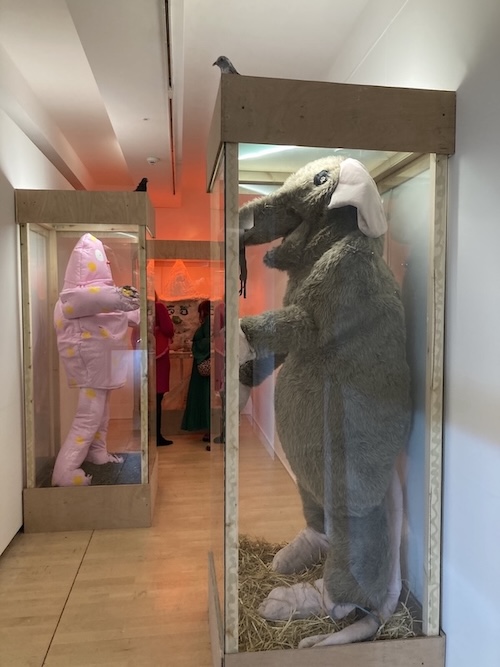
On top of Blobby and the Rat King’s vitrine are life-size pigeons, facing towards each other. Like the soil and the straw, they are another form of grounding or making real, and integrate the vitrines into the gallery, softening the edges and blurring the line between sculptural reality and ‘real’ reality. On one level it’s a purely aesthetic anchoring: the hard lines of the vitrine visually softened with the irregular or organic shape of the birds, but there’s also something more mysterious – with the tacit suggestion of animation. Perhaps they accompanied the vitrines on their journey here, or perhaps it is the figures themselves, barely contained in the vitrines as it is, that the pigeons somehow animate. They might be familiar spirits; or perhaps, noticing how the birds, standing sentinel, eyeball each other, it is the pigeons who are the power behind the throne, the intelligence that controls the hulking figures beneath? Interestingly, Mullen is not the only artist with a penchant for pigeons: Maurizio Cattellan has also exploited their banal yet mysterious quality.
The sheer thrown-togetherness of the vitrines is part of the pleasure of the ensemble: looping ribbons of glue gobbed between the perspex and ply, screws and brackets freely shown. There’s a DIY energy and freedom – the artist chasing an idea or a story, in pursuit of his own pleasure, world-building at speed, and leaving the details to be worked out later. The ‘bust’, Elf, takes the sketch energy further: it’s a huge head balanced on a ply table covered in detritus, Haribo tub half full of dried plaster. Elf has wonky teeth and an air of uncertainty, a green daub on his nose, a daub on one ear, quizzical eyebrows.
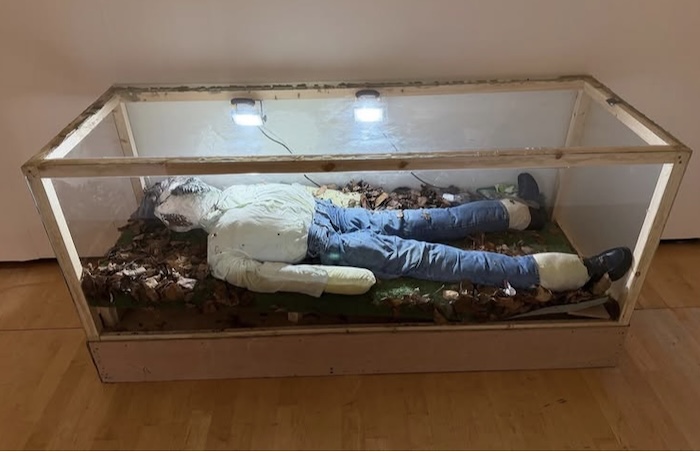
In the final horizontal vitrine, a human figure, perhaps sleeping, lies on astroturf, cranked up at one end with struts jammed in underneath to create an incline. Dead leaves lie strewn about, and an empty plastic bottle. The figure has the merest sketch of a face, with a skewed grey beard and wig, spectacles, jeans and loafers, swollen ankles, all harshly illuminated by two lights, black wires trailing down the back of the vitrine. The initial response is hilarity – partly, for me at least, because of the antecedents that come to mind; Elizabethan paintings of reclining noblemen by Nicholas Hilliard and Issac Oliver. Hilliard and Oliver’s exquisite rendering is matched by the equally exquisite self-seriousness of their subjects, and both are wildly incongruous in comparison with Mullen’s happily slapdash approach here; the elevated register of pastoral and chivalry replaced with the grubby and the ridiculous; with failure and finitude. The ‘descent from the elevated to the commonplace’ (OED) of bathos has a generosity which feels relevant to the experience of viewing this piece, as Paul Fleming explains: ‘The point of the ridiculous is not to criticize as if one knew better, but to participate in the fallenness of being – to revel in it.’ The political or ethical charge lies ‘in the expression of a solidarity pact between abandoned beings…’. It is not derision ‘but a form of empathy or understanding’ (2006, 46). Andrew McInnes takes it further: ‘Feeling ridiculous means experiencing a dark form of community with others, a communion based on failure, but failure that breeds empathy and solidarity, in contrast with the feeling of individual magnificence, even egotism, more usually associated with sublime feeling’ (2023, 201).
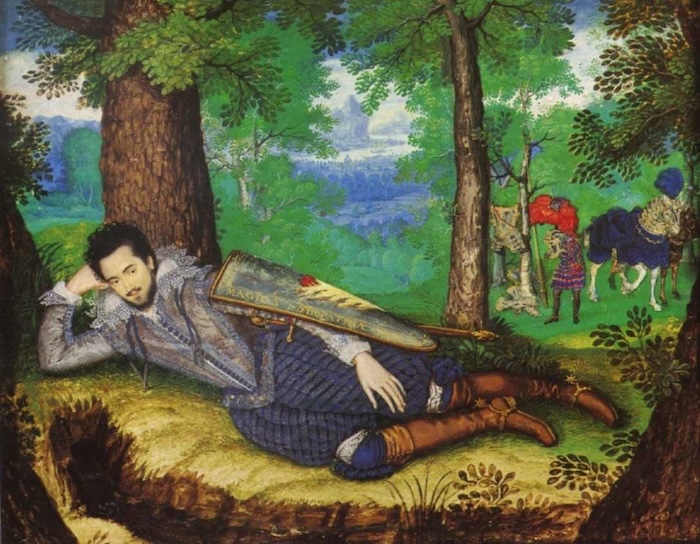
Edward Herbert 1st Baron Herbert of Cherbury by Isaac Oliver, 1610-14
But as with Blobby and the Rat King, there is the implication of something darker at work, provided by the title of the piece, ‘David Kelly’. It’s not clear which David Kelly is being referenced, but two possible candidates are both dead: David Kelly, the exuberant and prolific Irish character actor who died in 2012, or Dr David Kelly, the whistleblower authority on biological warfare who committed suicide in 2003. The title thus suggests death rather than sleep: failure and finitude taken to their inevitable endpoint.
Works cited:
Fleming, Paul. 2006. The pleasures of abandonment: Jean Paul and the life of humor. Würzburg: Königshausen & Neumann
Hogan, Michael. 2026. ‘A metaphor for a nation gone soft in the head’: the bizarre return of Mr Blobby’, The Guardian, 4 June,
https://www.theguardian.com/tv-and-radio/2026/jun/04/bizarre-return-of-mr-blobby
McInnes, Andrew. 2023. ‘From the Sublime to the Ridiculous’. In The Cambridge Companion to the Romantic Sublime edited by Cian Duffy, 193–206. Cambridge, UK: Cambridge University Press.


